

A studio in Queens
When Astoria, Queens, was better than Hollywood

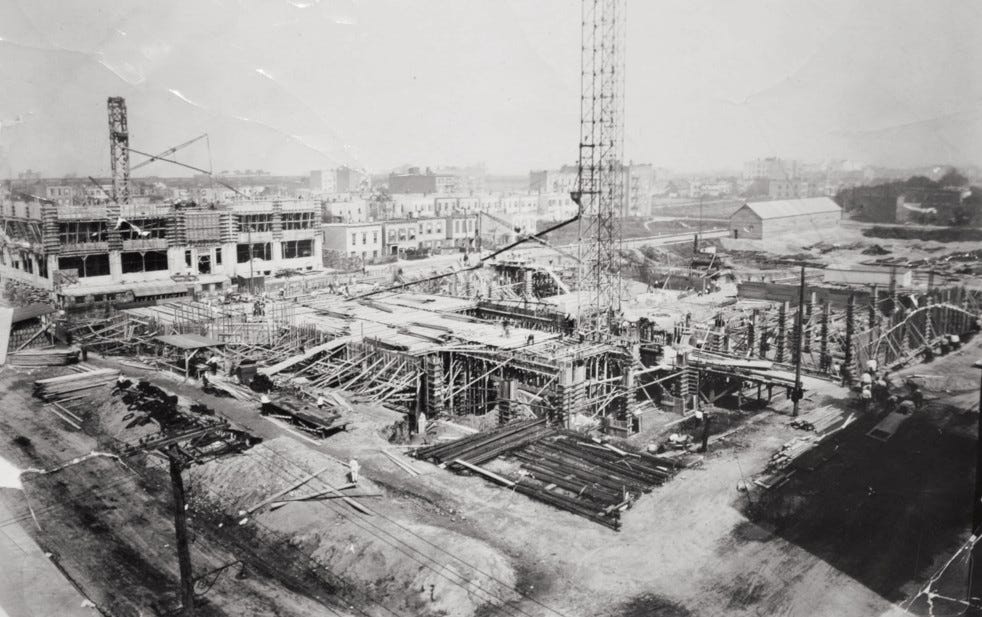
In 1917 an elevated line of New York’s rapid transit system was extended through Long Island City into Astoria, Queens. […] When the Queensboro Bridge opened in 1909, its eastern approaches were surrounded by vacant lots, but by the postwar era, the area was primed for rapid industrial and residential expansion. Cheap land, the easy commute from midtown, and the availability of plenty of nearby workers’ housing tipped the balance in favor of Astoria – or Long Island City, or even «Long Island», as New Yorkers then called anything east of the bridge. «For the benefit of those living west of Jersey City», Photoplay Journal confided, «Astoria was the garbage spot supreme of New York until Jesse Lasky or Adolph Zukor or somebody in the F.P.L. [Famous Players-Lasky] organization decided to build a studio there.» […]
Studio construction began in May 1919. Zukor had assembled the entire block bounded by Sixth and Seventh Avenues and Pierce and Graham Avenues, along with the block front on the north side of Pierce running from Fifth to Sixth Avenues, a total of 140,000 square feet of land.12 (Today, Pierce is known as 35th Avenue, and Sixth Avenue is called 35th Street.) Cameraman George Folsey set up his equipment on a 50-foot tower erected just across the street and produced a stop-motion ani mated film record of the construction, exposing a few frames of film every day. The smaller plot would be the new FP-L laboratory, the most sophisticated in the country. It would print and develop all Paramount films shot in the East and serve as a repair facility for Paramount’s national film exchange operations. The first floor housed a modern machine-developing system; on the second floor, a more conventional drum-and-tank arrangement could process between 750,000 and 1,000,000 feet of release print a week (replacing the operations of four other labs scattered around New York and New Jersey). Most impressively, the building was designed with climate controls to monitor temperature and humidity in each room.
The studio building occupied most of the larger site, fronting on Pierce Avenue, with the balance of the lot kept available for the construction of exterior sets. It was designed by the Fleischmann Construction Company to accommodate twenty production units working simultaneously. The main stage was an enormous interior space measuring 120x218 feet, with a height of 50 feet, enclosed by three stories of shops, offices, and dressing rooms. The original plans called for this area to be covered by a great glass vault, «to provide natural daylight so as to make it possible to take scenes practically from sunrise to sunset without artificial light.» Given the scale of the new studio, this was a completely impractical notion, and during construction the glass roof was eliminated, to be replaced by a revolutionary system of studio lighting first used a few months earlier during the renovation of the Amsterdam Opera House.
Richard Koszarski, Hollywood on the Hudson: film and television in New York from Griffith to Sarnoff, Rutgers University Press, 2008.
«There was a wonderful sense of revolution and innovation in the studio in Queens.»
Gloria Swanson in «Swanson On Swanson», Random House, 1980