

(Literally) killed by a joke
… there’s an insurance for that!

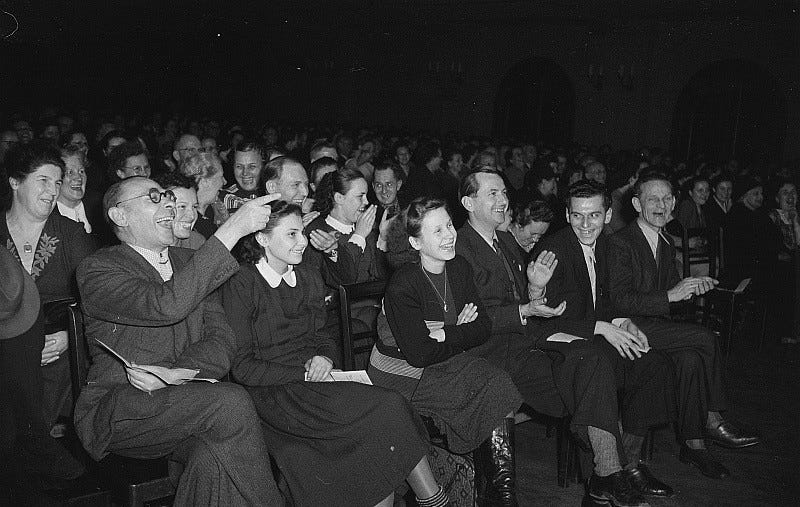
Imagine being so wild and free that your laughter literally killed you. The funniest comedian’s worst nightmare betrays humor’s ultimate utopian wager: to die laughing - to take flight from the world in the throes of unbearable pleasure and outrageous ecstasy. «Though extremely rare, even laughter can be a killer», warns Trusted Choice. Death-by-laughter insurance dates back to the early 1900s (in their telling), when «a group of giggly (yet timid) cinemagoers» hired the firm Lloyd’s of London «to issue a policy that would cover them in the event they actually died laughing. Now that’s pretty funny». What film could provoke such dangerous mirth? Was it Tickled to Death (1909) in which a woman brings her dead husband back to life by tickling his feet with a hat feather? Or perhaps That Fatal Sneeze (1907), an unorthodox comedy about nasal catastrophe? Although preposterous, death-by-laughter insurance would have been a perfectly sensible precaution at the time.
From 1870 to 1920, hundreds of women reportedly died from laughing too hard. Bertha Pruett was «Killed By A Joke» in 1893 when a young man (and «noted wit») made a risible remark at a dinner party that «threw Miss Pruett into a violent fit of laughter» that «suddenly changed to a cry of pain and she fell to the floor… Dead». The unnamed jokester was not a professional comedian, unlike the thespians whose riotous performance on opening night at the theater caused Mrs. Charles S. Stuber (age thirty-three) to die of acute indigestion incited by excessive laughter [1916]. Mrs. Polly Ann Jackson «had not laughed so hard in months as at the story told her which caused her death» in Kentucky in 1906.
Movie exhibitors gleefully exploited fatal anxieties about risible mortis in their devilish gambits, offering to insure all patrons against «loss of life» due to «unrestrained laughter». For example, The Ontario Equitable Life and Accident Insurance Company issued a policy to «every man, woman, and child» attending Lord Chumley in Canada (1925) - advertised as «THE JOLLIEST BANG-UP COMEDY IN YEARS!» - with a «proviso that death [must] occur during the performance». (Viewers who laughed themselves to death after the last shot would be sadly out of luck.) The stunt made a killing and reaped an «immediate profit» as people flocked to test their enjoyment against the postmortem promise of $1,000 cold hard cash. «Life insurance for death by laughter is another exploitation stunt which has caught on», opined The Exhibitors Trade Review in 1923 in a recurring section titled «Exploitorials».
Liability hazards engulf the comedy industry today, but the target has shifted from laughing spectator to edgy practitioner. Comedians face litigious backlash for everything from plagiarism to gender bans to mother-in-law jokes, exemplified by the 2009 «MOTHER-IN-LAWSUIT» against Sunda Croonquist whose outraged in-laws sued her for «making too many mother-in-law jokes» in her stand-up act. In contrast, Charlize Theron absolved Sacha Baron Cohen in 2019 after she «was hospitalized for five days» from «laughing too hard while watching Borat.» (She had a herniated disk but Borat was «the straw that broke the camel’s back».)
Maggie Hennefeld, Death by Laughter - Female Hysteria and Early Cinema, Columbia University Press, 2024.