

Max Factor and King Greasepaint
The makeup revolution of the 1920s

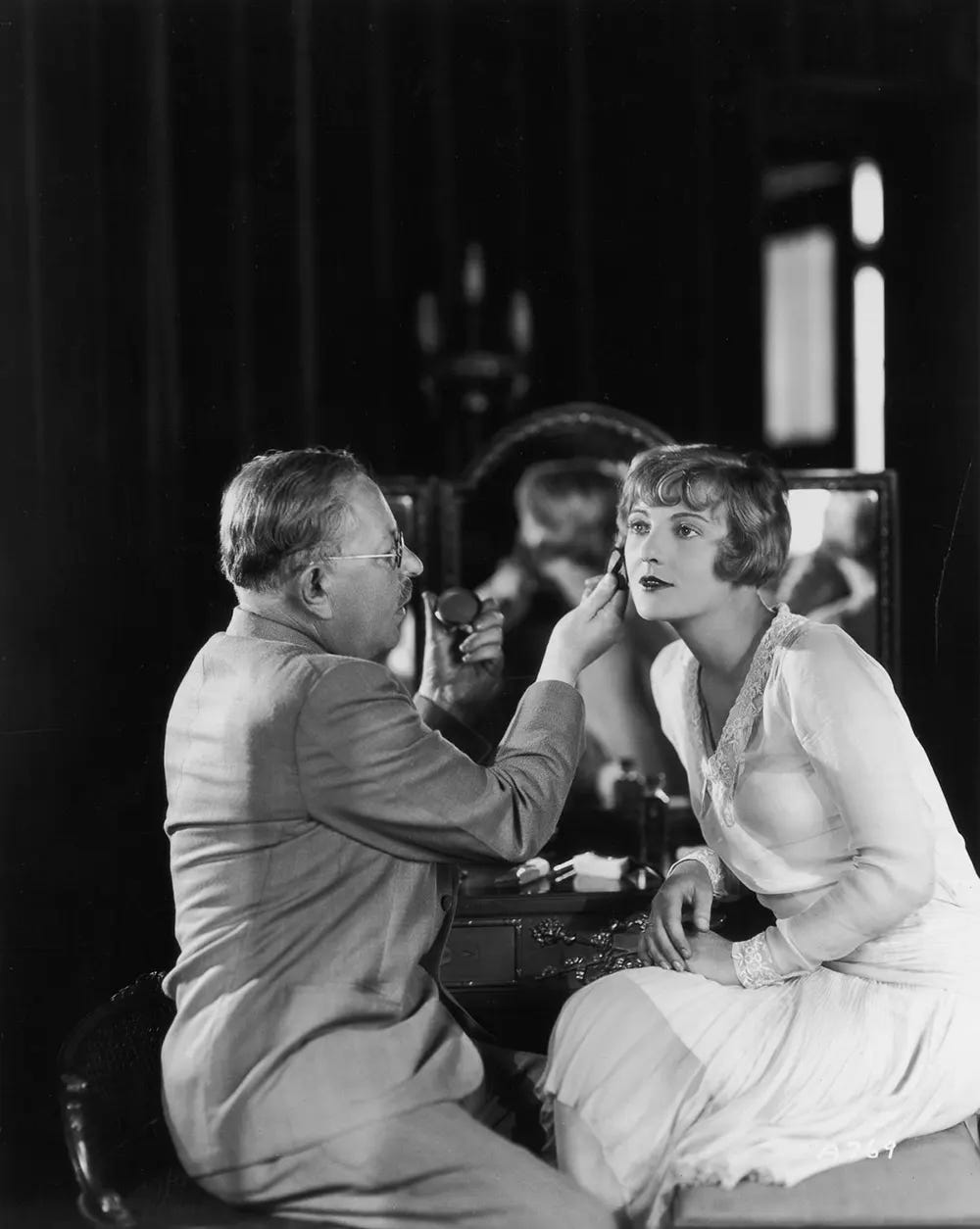
The advent of synchronized sound with the 1927 film The Jazz Singer signified the end of the silent picture era, a transition that brought with it a host of technical issues. The jump from the blue-sensitive orthochromatic film to the use of full color–range panchromatic called for new lighting and makeup solutions.
Despite Factor’s groundbreaking formulation with Supreme Greasepaint some ten years earlier, technology was changing. Factor’s greasepaint, which had once worked wonders, now clashed with panchromatic film. Stars who had loved the once-indispensable makeup were faced with the prospect of having to appear on screen looking like something from a horror film or, even worse, appear with a naked face before the camera.
A 1920s newspaper article, from the personal scrapbook of Cecil B. DeMille, describes the changing industry standards and sentiments of the time:
Since the beginning of the motion picture industry, greasepaint, in a multitude of forms, has ruled the screen. Now suffering film folk and also suffering film fans are seeing its overthrow. Improved cameras, better lighting and more sensitive film are making it possible for the star to appear before the lens without reinforced layers of grease and cosmetics. In early days, faces were done in yellow to make them photograph lighter. Since then they have passed through most of the colors of the rainbow, with some actors even using blue and purple paints to gain a better effect. Women with their finer skin and lighter coloring faired well enough but the «he-men» of the thrillers were wont to be reflected with faces of «ghastly pallor» but with necks and arms that photograph as shocking challenge to soap and water. But even with the technical improvements made dethroning of King Greasepaint is not without a struggle. Actors recruited from the stage are hard to wean from the grease pot. They blush at the facial nudity of acting a part without a mask of paint. The announcement that Cecil B. DeMille [made] that he will produce his next picture without grease paint being used by any of the players stirred some protest, more of it, surprisingly, from the men than from the women. […]
The onset of the makeup upheaval prompted Max to get busy experimenting on a more viable option that would complement the complexion of the actors and work well with panchromatic film. In addition to considering matters of color (unlike orthochromatic, panchromatic film was sensitive to a full color range within black-and-white film), Max was aware of the psychological effects that going before the camera sans makeup could have on his actors, whose very livelihoods hinged on how flawless their faces appeared. Factor joined forces with the motion picture studios. Together they worked to develop a formula that was compatible across the board. After nearly two years of experimentation, Factor would emerge with Panchromatic Makeup. Thinner than Supreme Greasepaint, more natural to the touch and easy to apply, Panchromatic Makeup (still largely referred to as «greasepaint») worked wonders in solving technical issues where color was concerned and made stars’ complexions appear even more perfect on screen than they previously had. And unlike Supreme, Panchromatic contained powder to reduce shine and, thus, reflection on camera.
Max Factor had created a formula so relevant that it would set the industry standard from that point forward, becoming the makeup against which all motion picture studios would measure their products. And nearly every movie studio in the United States and Europe would stock the shelves of their makeup departments with it.
Erika Thomas, Max Factor and Hollywood: a Glamorous History, The History Press, 2016.