

Remote from every human gaze
Francesca Bertini, diva

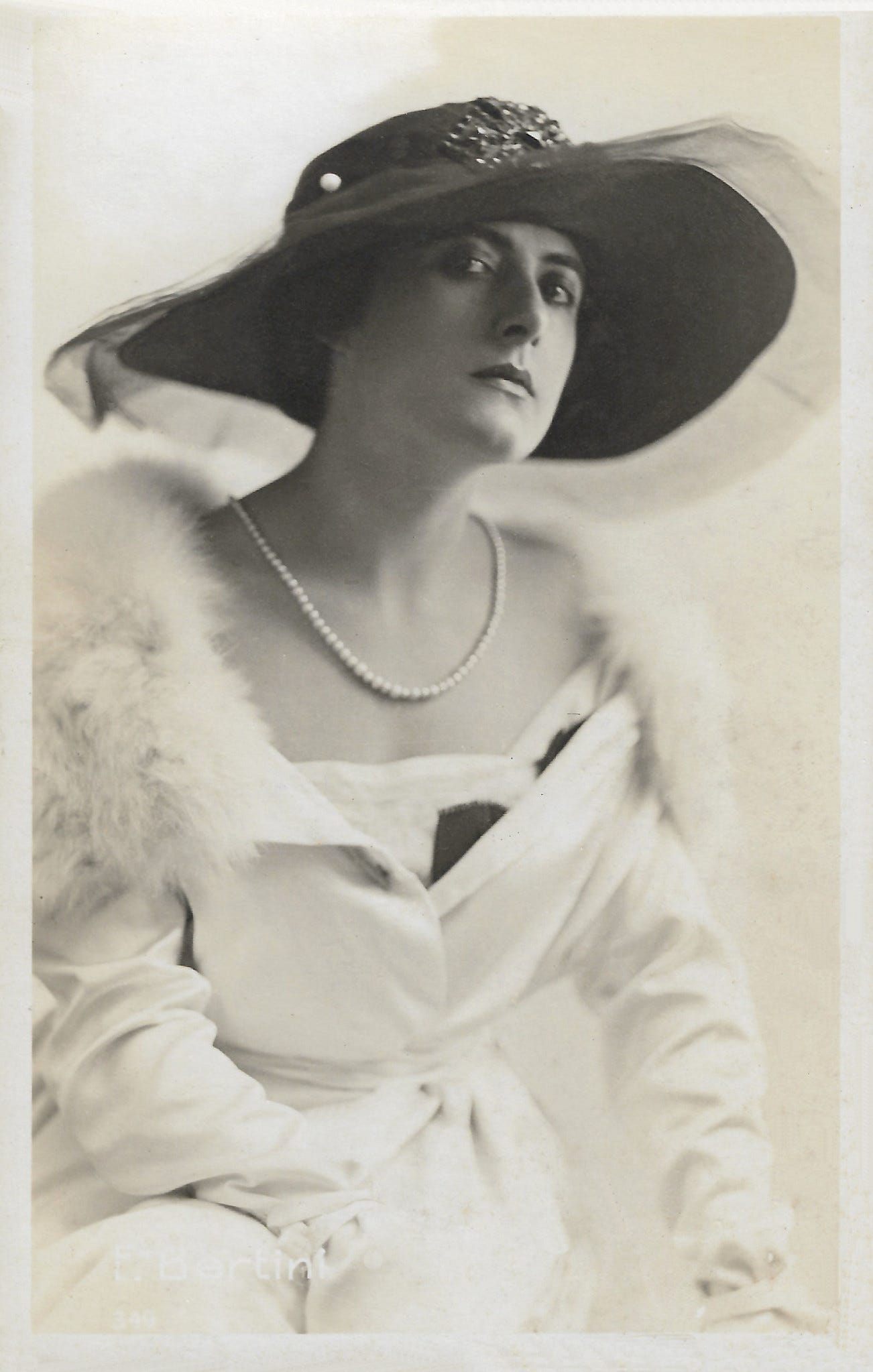
[Original Italian below]
Before she vanished from Italian life, I saw her in Rome, in 1922, at the Teatro dell’Opera. To any student of social custom the theatre offered three figures well worthy of observation, that evening. Count Greppi, who was hundred and one year old, was in attendance as on every other evening – white-tied and tail-coated, seated in the stage-box of the Hunting Club, surveying the performance with the unruffled composure of a patriarch. In a first-tier box to the right sat Giacomo Puccini. The work being presented was La Bohème, and the evening had been arranged in his honor. In another first-tier box sat, lastly, Francesca Bertini, recently married to the French Count Cartier.
No one spared a glance for Count Greppi – that figure who appeared to have embarked upon his diplomatic career in the days of King Carlo Alberto himself. Few, beyond the obligatory bursts of applause, troubled themselves over Puccini. Every eye was fixed upon Francesca Bertini.
Undaunted beneath two thousand gazes rising from the stalls and pressing down from the galleries, the diva – whose films had been screened in private for the court of the Tsars before ever they were released to the Russian public; the Russians, it may be said, fell in love with the cinema because they fell in love with Francesca Bertini, and in the ardour of that passion set her one rung above Mary Pickford, above Asta Nielsen, above Pola Negri – continued to converse, quite serenely, with her husband and the other guests in her box.
Few women, perhaps, have ever existed in the world so beautiful as she, so perfectly beautiful in the Italian manner. She was beautiful as a Neapolitan song is beautiful, as the mysterious woman is beautiful for whose sake men have sung ’O sole mio, sta ‘nfronte a te. Her beauty demanded the sort of adjective one finds in an opera libretto – it called to mind a lunar beauty, a beauty made for serenades, like that line from the last century which runs: «Among the boughs the moon appears, resplendent». She was, in a word – and it is a word so perilous in its extravagance as to be almost forbidden - of a resplendent beauty.
When she took her leave, she found the foyer and the street without being overrun by a crowd which had drawn itself into ranks to watch her pass. What befell her was that very thing which chroniclers of the Second Empire recorded as having come to pass in the salons of the Tuileries the first evening the eighteen-year-old Countess of Castiglione appeared there, when the ladies in their wide crinolines allowed themselves to be lifted upon the arms of their escorts and clambered onto console tables as she drew near the throne of the Empress Eugénie.
Elena Vitiello – known to the world as Francesca Bertini – passed through as though not a soul were looking on. She passed, wrapped in her ermine, with the assured and sovereign air of a woman who feels herself alone and content before her own looking-glass, remote from every human gaze.
Orio Vergani, «Le belle italiane» in La donna italiana nel Novecento, L’Illustrazione Italiana, Natale-Capodanno 1947.
Prima che scomparisse dalla vita italiana, la vidi a Roma, nel 1922, al Teatro dell’Opera. C’erano quella sera in teatro, per uno storico del costume, tre figure da osservare. Il conte Greppi, che aveva compiuto in quei giorni cento e un anno, come tutte le altre sere assisteva in frack, dalla barcaccia del circolo della Caccia, allo spettacolo. In un palco di prim’ordine, a destra, stava Giacomo Puccini. Si rappresentava la Bohème e la serata era dedicata a lui. In un palco pure di prim’ordine c’era, infine, Francesca Bertini, sposata da poco tempo con il conte francese Cartier.
Nessuno guardava il conte Greppi, l’uomo che pareva avesse cominciata la sua carriera di diplomatico al tempo di Carlo Alberto. Pochi, dopo l’applauso di rito, si occupavano di Puccini. Tutti guardavano Francesca Bertini.
Impavida sotto duemila sguardi che salivano dalla platea e stendevano dalle gallerie, la diva i cui film venivano proiettati privatamente alla corte degli czar prima di esser passati in visione alla Russia – i russi si innamorarono del cinema perché si innamorarono di Francesca Bertini e la collocarono nella loro passione un gradino più in su di Mary Pickford e di Asta Nielsen e di Pola Negri – continuava tranquillamente a conversare con suo marito e con gli altri ospiti del palco. Poche donne, forse, erano state, al mondo, belle come lei, italianamente belle come lei. Era bella come una canzone napoletana, come la misteriosa donna per la quale è stato cantato O sole mio, sta’ in fronte a te. Meritava, la sua bellezza, un aggettivo da librettisti, e faceva pensare a una bellezza lunare, a una bellezza da serenate, come quella ottocentesca che dice: «Tra i rami fulgida la luna appare». Era appunto, con un aggettivo di uso tanto difficile da dover esser quasi proibito, di una bellezza fulgida. Quando uscì, trovò l’atrio e la strada invasi da una folla che si era schierata per vederla passare, Accadeva per lei quello che i cronisti del Secondo Impero narrano sia accaduto nei saloni delle Tuileries la prima volta che vi apparve la diciottenne contessa Castiglione, e le dame dalle lunghe crinoline si fecero sollevare sulle braccia dai loro cavalieri e si arrampicavano sulle consolles mentre si avvicinava al seggio di Eugenia di Montijo. Elena Vitiello, in arte Francesca Bertini, passò come se nessuno la guardasse, passò. chiusa nella sua pelliccia di ermellino, con la sicurezza della donna che si sente sola e felice davanti a uno specchio, lontana da ogni sguardo d’uomo.