

That inexplicable something
Alice Guy-Blaché, pioneer

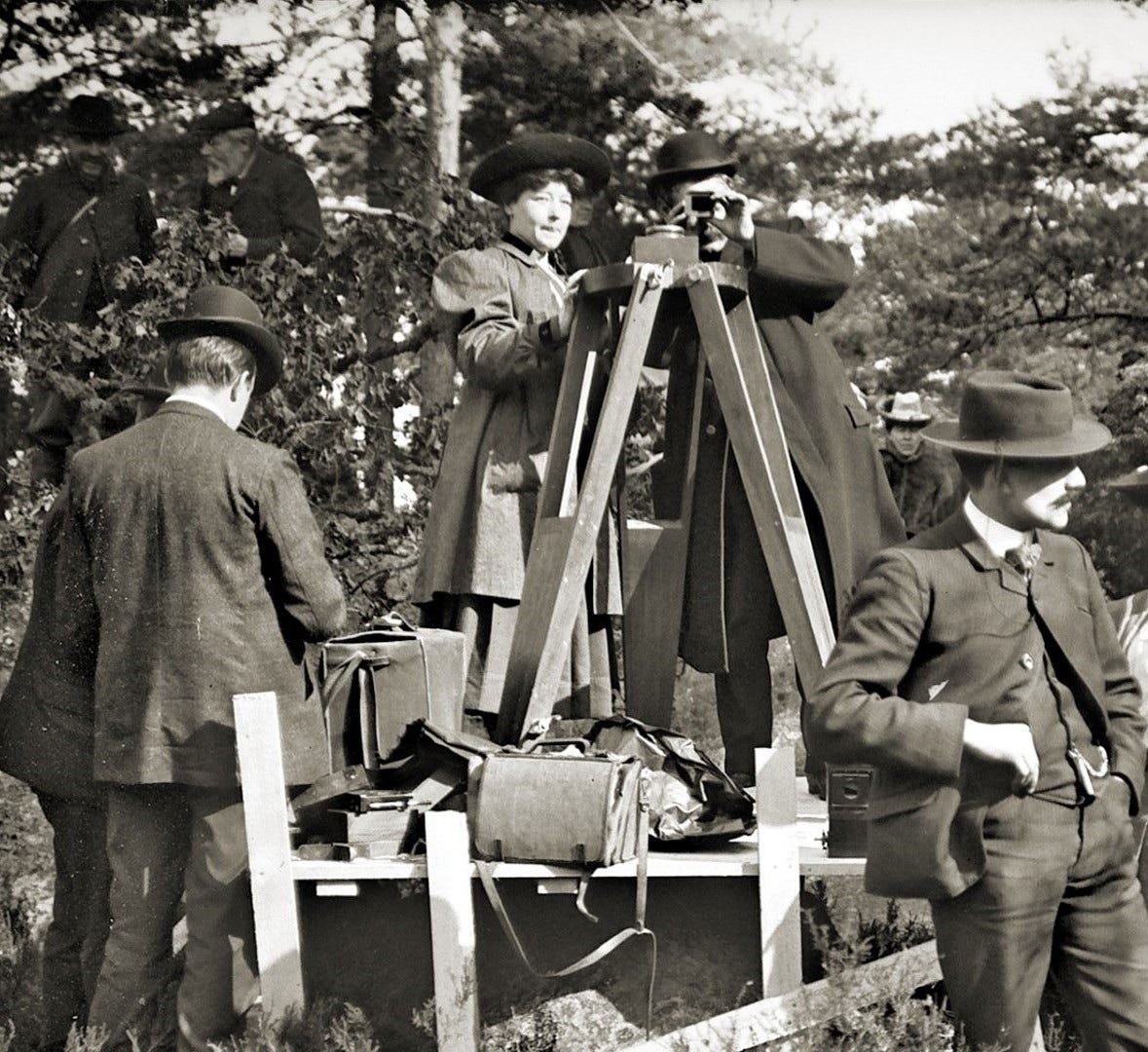
There is no doubt in my mind that a woman’s success in many lines of endeavors still made very difficult by a strong prejudice against one of her sex doing work that has been done only by men for hundreds of years. Of course this prejudice is fast disappearing, and there are many vocations in which it has not been present for a long time. In the arts of acting, music, painting, and literature, woman has long held her place among the most successful workers, and when it is considered how vitally all of these arts enter into the production of motion pictures, one wonders why the names of scores of women are not found among the successful creators of photodrama offerings.
Not only is a woman as well fitted to stage a photodrama as a man, but in many ways she has a distinct advantage over him because of her very nature and because much of the knowledge called for in the telling of the story and the creation of the stage setting is absolutely within her province as a member of the gentler sex. She is an authority on the emotions. For centuries she has given them full play while man has carefully trained himself to control them. She has developed her finer feelings for generations, while being protected from the world by her male companions, and she is naturally religious. In matters of the heart her superiority is acknowledged, and her deep insight and sensitiveness in the affairs of Cupid give her a wonderful advantage in developing the thread of love and plays such an all-important part in almost every story that is prepared for the screen. […]
That women make the theatre possible from the box-office standpoint is an acknowledged fact. Theatre managers know that their appeal must be to the woman if they would succeed, and all of their efforts are naturally in that direction. This being the case, what a rare opportunity is offered to women to use that inborn knowledge of just what does appeal to them to produce photodramas that will contain that inexplicable something which is necessary to the success of every stage or screen production.
There is nothing connected with the staging of a motion picture that a woman cannot do as easily as a man, and there is no reason why she cannot completely master every technicality of the art. The technique of the drama has been mastered by so many women that it is considered as much her field as a man’s and its adaptation to picture work in no way removes it from her sphere. The technique of motion-picture photography, like the technique of the drama, is fitted to a woman’s activities.
It is hard for me to imagine how I could have obtained my knowledge of photography, for instance, without the months of study spent in the laboratory of the Gaumont Company in Paris at a time when motion-picture photography was in the experimental stage, and carefully continued since [in] my own laboratory in the Solax Studios in this country. It is also necessary to study stage direction by actual participation in the work, in addition to burning the midnight oil in your library, but both are as suitable, as fascinating, and as remunerative to a woman as to a man.
Alice Guy Blaché, «Woman’s Place in Photoplay Production» in The Moving Picture World, vol. XXI, No. 2, 1914 (in The Memoirs of Alice Guy Blache, Scarecrow Press, 1986)