

The First Influencers
A 1916 account of fandom, celebrity obsession, and the birth of influencer marketing

Motion pictures are to-day a force to be reckoned with, and the national advertiser can not do better than to take advantage of the weaknesses of the fans, who are enrolled from all walks of life, and no one, from the boy in short pants to the old man of seventy, is immune. When they get the motion-picture bug badly – and the majority succumb – their interest in a photoplay only really commences when they view it at their pet theater. They next turn to their encyclopedia – the latest issue of their favorite photoplay publication – in which they will probably find the story of the play and some dope on the producing of it. By the time they are through they are sure to know the photoplay from A to Z
The star player is a greater magnet than the play. The fans literally pester the lives out of their screen idols via Uncle Sam’s mails, and generally implore their pet magazine to publish an interview. Practically anything linked with a motion-picture star is sure to find a ready response. You can not secure a popular photoplayer to appear in a thinly disguised advertising film, so the next best thing you can do is to work along lines which other advertisers have successfully tried out. Here follow some examples.
Pearl White, of Exploits of Elaine fame, was shown in an ad. which appeared in the Motion Picture Magazine, wearing Vantine’s Panama hat.
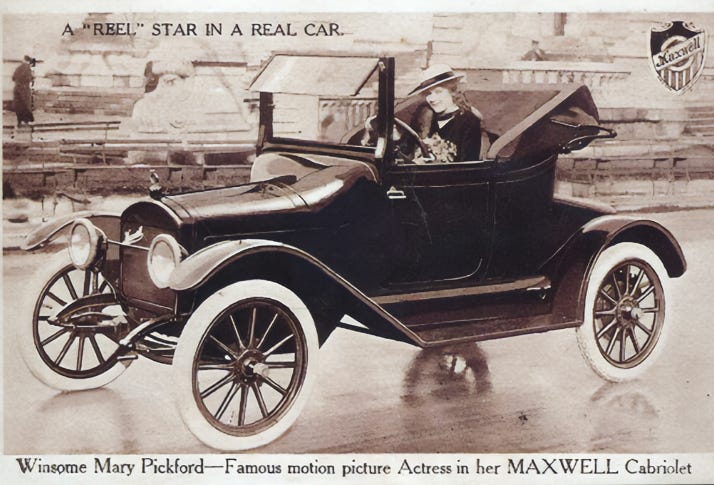
Mary Pickford owns a Maxwell Cabriolet, so the manufacturers secured a snapshot of her boarding her car. The photograph was used in a New York Morning Telegraph ad. to back up the following argument: «This car is the easiest car in the world for a woman to drive. That is why Mary Pickford selected it».
A photograph of Lillian Walker in a smiling pose accompanied an ad. in the Motion Picture Magazine for Carmen Complexion Powder. This was the significant argument: «One that adds every charm to your complexion, as well as Lillian Walker’s, without seeming artificial».
Marguerite Snow supplied the following testimonial for Sempre Giovine: «I am pleased to attest to the merits of your skin preparation, Sempre Giovine, conscientiously, having found it a necessary adjunct to my toilet table. Its use after a day out in all kinds of weather leaves the skin in a velvety condition». This supplied the «pep» to a full-page announcement in the Photoplay Magazine.[…]
National advertisers, up to the present time, have paid considerably more attention to the heroines than the heroes. Possibly it is because it is much easier to appeal to the women, but the odds should be more balanced. Tobacco, hosiery and sporting-goods manufacturers are to name just three kinds of advertisers who could employ a prominent male player to advantage.
Why not name the next new branded article you put on the market after a motion-picture star? I happen to have advance information of a cigar manufacturer who has christened a new cigar after King Baggot. I understand, too, that Lillian Walker, Edward Earle, Leah Baird and Eleanor Woodruff are open to receive offers.
How can the photoplayers be approached? In the first place, a player can not secure too much publicity, and if he neglects this important factor he loses much of his popularity. Great as is a motion-picture player’s need for publicity, he will seldom allow his name to be exploited by an advertiser without adequate remuneration, as he feels that he, too, should reap some of the financial benefit.
Ernest A. Dench, Advertising by Motion Pictures, The Standard Publishing Company, 1916,