

The industrialized bride
Labor, consumption, and spectacle in Lubitsch’s «The Oyster Princess»

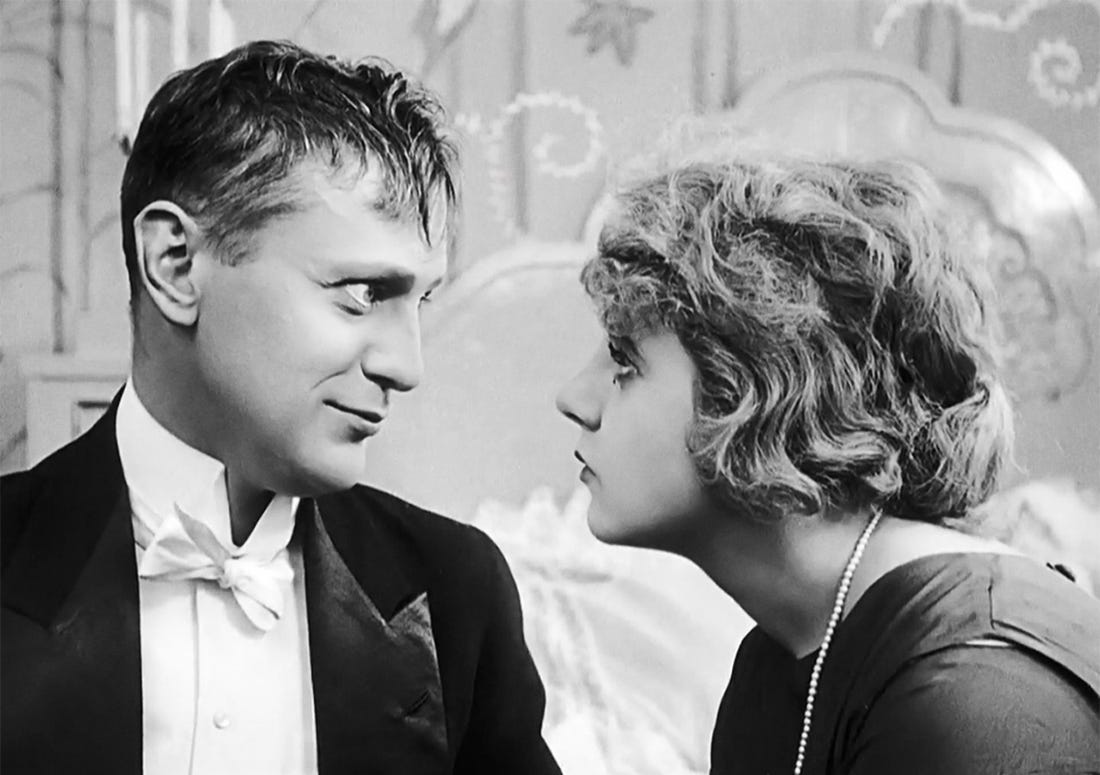
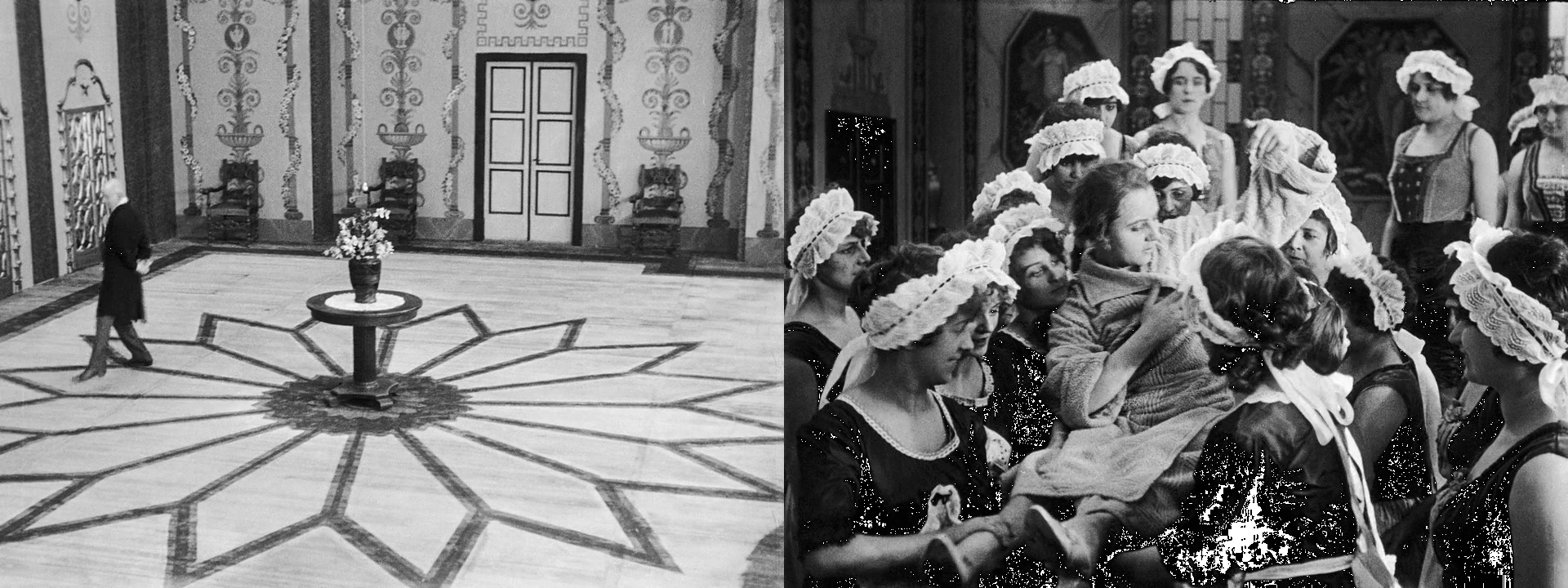
[In The Oyster Princess] Prince Nucki (Harry Liedtke) inspires most of the humorous comments on the loss of male power and the threat of feminization. Since he is still too class-conscious to break a date with his bohemian friends, Nucki sends a valet to investigate the actual wealth of the Oyster Princess. Having arrived at her spectacular palace, the false prince is asked to wait in the drawing room and soon begins to trace nervously the pattern of the star-shaped floor, turning and spinning with increasing speed until nausea clouds his senses. The drawing-room scene alternates with scenes from the dressing room where the Oyster Princess reigns supreme, surrounded, as her father before, by countless maids who scrub, comb, cream, perfume and, eventually, dress her. Here the allusions to new developments in industrial production are all too evident. With the woman’s body representing the product, specialized groups of workers (maids) – distinguishable by their uniforms (aprons, frocks, caps) – enter the process of production (woman’s beautification) at different stages and perform their respective tasks (cleaning, massaging, dressing), a process made even more visible through the repeated close-ups of hands at work. The staging of woman’s transformation into a spectacle imitates early forms of the conveyor belt where the workers still follow the product through all the steps of a production assembly; at one point, for instance, the Oyster Princess is carried from the cleaning section to the massage section.
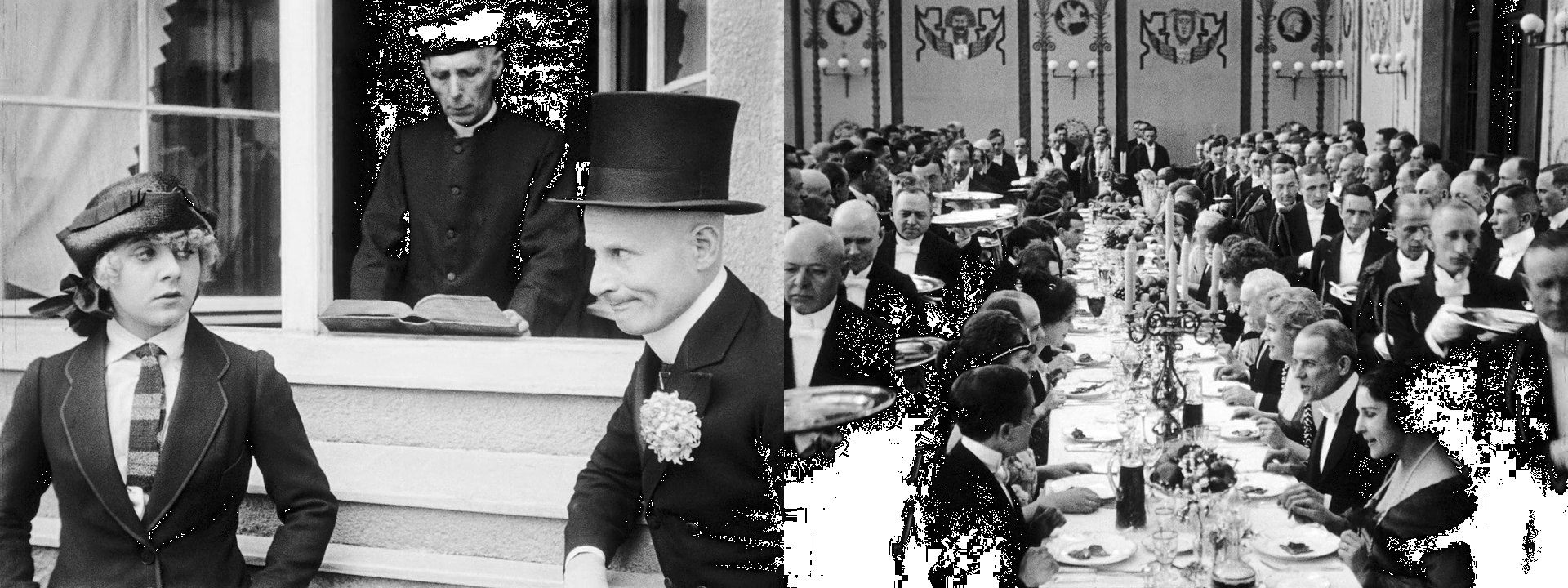
Eventually, the Oyster Princess enters the drawing room – very much like a luxury item on display. But contrary to the expectations raised by the previous sequence, it is the woman (i.e. the product) who does the «buying». After inspecting the prospective groom with a monocle, the determined girl follows through with her original plan and, without delay, drags him to a pastor who performs the wedding ceremony from the window of his private home. Such lack of etiquette is more than compensated for during the splendid wedding party, with its masterly choreographed scenes of eating and dancing. As the bride whispers saucily: «Say something!» the false groom replies with a full mouth: «I haven’t had such good food in ages!» Then consumption takes over and triumphs as the film’s underlying principle, in the process annihilating the exigencies of narrative linearity and succumbing to a more «primitive» celebration of the spectacular. Grafe and Patalas write: «For the wedding party, Lubitsch hired three hundred real waiters. Behind each guest another waiter stands for each course. After each course the dish vanishes and so does the waiter. The next row steps up. The notion of consumption as real, devouring consumption is thus made obvious. Consumption has something literary in the Lubitsch films, something exhilarating».
Creating a feeling of vertigo in the film’s protagonists, as well as in the spectators, the wedding sequence culminates in a jubilant apotheosis of the body. What begins as a chorus line of waiters winding up and down the stairs with plates of food, of cooks preparing meals and guests chewing relentlessly, gradually turns into more abstract rituals. Through rapid editing, odd camera angles, lighting, and special effects, movement becomes dance and dance the celebration of life.
Sabine Hake, Passions and Deceptions: The Early Films of Ernst Lubitsch, Princeton University Press, 1992